

Photo by Gerd Altmann from Pixabay
Today, businesses operate in a complex economic environment, under pressure from rising costs, the need for optimised management, and the urgent demand for sustainability. One of the heaviest burdens remains the uncertainty surrounding energy costs: the real challenge is maintaining competitiveness without sacrificing production due to unpredictable bills.
Often, despite digital transformation, there is no clear picture of where and how energy is consumed, making it difficult to identify waste. Energy efficiency is no longer an option, but a strategic imperative.
The solution?
Energy Intelligence.
What is Energy Intelligence and why is it essential?
Energy Intelligence (EI) is the strategic use of advanced technologies and data analysis (such as AI and machine learning) to gain a comprehensive overview of a company’s energy management.
It’s not just about ‘reading a meter’: EI monitors and optimises consumption in real time, forecasting future demand and enabling more sustainable and cost-effective decisions.
Adopting Energy Intelligence solutions means transforming energy consumption into actionable data, delivering tangible benefits:
- Predictive cost management: by analysing consumption patterns, algorithms forecast future demand, enabling contracts to be optimised and costly peaks to be avoided.
- Operational optimisation: the EI integrates with existing systems (ERP, BMS), providing a single view that allows you to immediately identify which machine or process is wasting resources.
- IT security: the system detects anomalies or potential faults in the infrastructure before they become critical.
- Measurable sustainability: accurate data enables companies to transparently demonstrate improvements in efficiency, thereby strengthening their green reputation.
Furthermore, these solutions enable the company to align itself with Industry 5.0 principles and access tax benefits such as tax credits. Investment in ‘energy intelligence’ solutions (artificial intelligence for the energy sector) is, in fact, covered by the Transition Plan 5.0, which offers a tax credit for investments in digital and energy innovation projects aimed at reducing consumption.
The Nexeeva case: real efficiency on production lines
Nexeeva, in partnership with WAGO, has developed an advanced energy management solution. The aim? To obtain real-time data on the efficiency of production lines: measuring how much energy is consumed, and identifying where and why.
How the Nexeeva solution works
The system combines the precision of field devices (smart meters, sensors and WAGO modules) with the intelligence of management data (ERP/MES). The solution monitors the energy consumption of machinery and collects detailed electrical data (voltage, current, active and reactive power).
The real added value lies in integration: Nexeeva links this energy consumption to actual production. By cross-referencing energy data with work orders, production stages and machine running times, the system generates precise efficiency and cost metrics for each individual job.
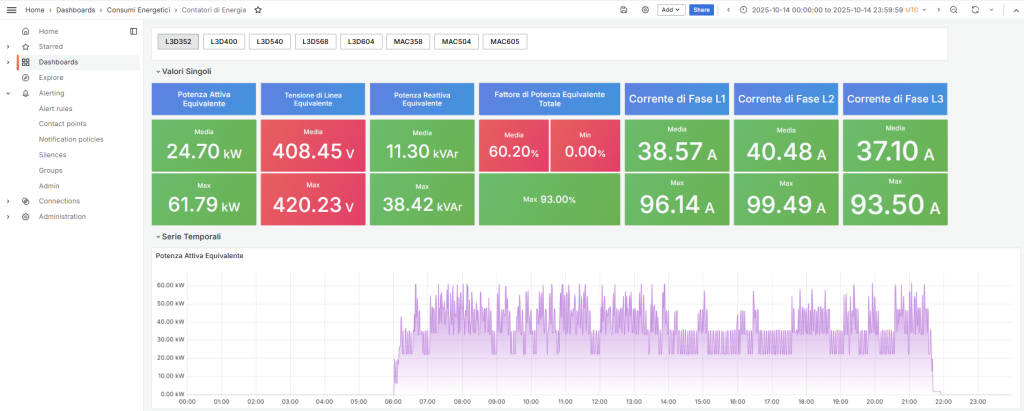
The data that is collected and analysed comes from:
A) Devices connected to machinery
- WAGO energy analysers / energy meters
- Industrial I/O modules
- Current transformers (CTs)
- Sensors connected via RS485/Modbus or Ethernet/Modbus TCP
B) Production information
- Work orders
- Machine states: running, in cycle, stopped, standby, alarm
- Production volumes, scrap, cycle times, set-up times
C) Any line PLCs
- PLC readings
- Digital signals (cycle start/stop, alarms)
- Analogue signals (temperature, pressure, speed)
This data is collected via a technical pipeline, a series of automated steps that take the software from the development phase to the end-user phase, following these steps:
- Field devices (power meters or WAGO modules) measure power consumption and electrical parameters in real time.
- The data is transmitted via Modbus RTU (serial) or Modbus TCP/Ethernet to a gateway.
- A WAGO PFC controller or edge device aggregates and normalises them.
- The data is sent via:
- MQTT
- REST API
- Database
- Elasticsearch
- The NexOne management and automation software integrates them and links them to the production data retrieved from the ERP.
Once collected, the data is standardised and archived for three purposes:
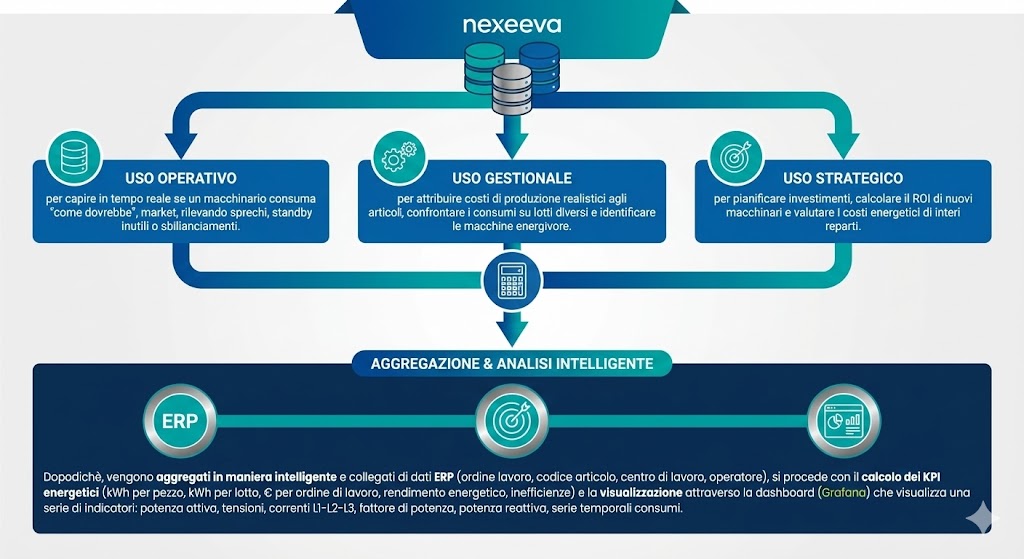
They are then intelligently aggregated and linked to ERP data (work order, item code, work centre, operator), after which energy KPIs are calculated (kWh per unit, kWh per batch, € per work order, energy efficiency, inefficiencies) and displayed via the dashboard (Grafana), which shows a range of indicators: active power, voltages, L1–L2–L3 currents, power factor, reactive power, and consumption time series.
Why use energy intelligence? The benefits for your business
Choosing the solution developed by Nexeeva using WAGO technology turns energy measurement into a competitive advantage, with measurable benefits:
- Greater control over actual production costs and greater accuracy in calculating unit costs.
- Reducing energy wastage and penalties.
- Support for predictive maintenance, helping to prevent machine downtime.
- Optimisation of planning and shift schedules based on reliable data.
Would you like to turn your consumption into a strategic asset?
Contact us