Home / Blog / Machine data collection and analysis in manufacturing: how to eliminate production ‘blind spots’
Machine data collection and analysis in manufacturing: how to eliminate production ‘blind spots’
Implementing a data collection and analysis solution is not just a technological upgrade: it is a strategic investment
In today’s industrial landscape, many companies still operate with what might be described as a technological ‘blind spot’. These are companies that have state-of-the-art machinery operating 24 hours a day, yet remain unaware of the actual performance, the condition of components or the actual downtime of their production line. What does this mean? It means that the information generated by production activities exists, is contained within the machinery, but often remains unspoken: it is neither read nor interpreted.
In this article, we will look at how businesses today can adopt effective solutions that transform raw data into strategic decisions through a secure and scalable process of innovation and digital transformation.
The problem: ‘invisible’ production
Let’s imagine the situation of a manufacturing company with various production assets. Management is well aware of ‘how much and what’ is coming out of the factory in terms of finished products, but problems arise when they struggle to answer crucial questions such as these with any precision:
Why did that machine experience three brief stoppages today?
What is the real-time energy consumption of the machinery in relation to the volumes produced?
What is the actual state of wear and tear of themachine’s components before a fault occurs?
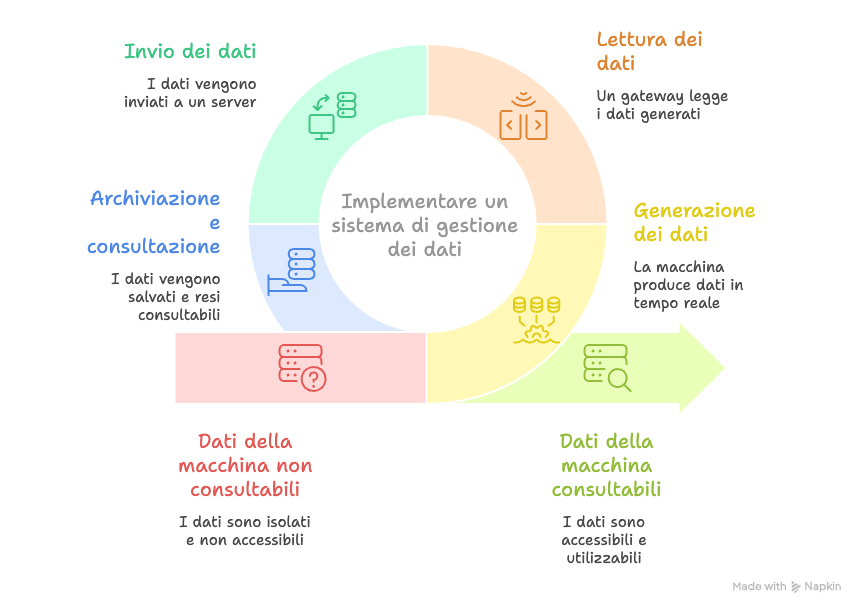
Without a centralised overview, data is fragmented. This means that whilst certain information can be read directly on the machine’s display, this information is not recorded historically nor can it be compared over time. This gap between the physical world of production and the digital world of business management prevents companies from optimising costs and improving competitiveness.
“Most Italian companies have modern machinery but do not analyse the data it generates. In effect, they have bought the ‘engine’ of innovation but leave it switched off, operating in a constant information blind spot”
The data paradox: many generate it, few analyse it
Although the sector is growing rapidly, only 42.7% of companies (with at least 10 employees) carry out data analysis using in-house staff or external organisations. This means that almost 6 out of 10 companies still operate without a structured data culture(source: “Businesses and ICT”, Istat 2025).
Analysis: where the data comes from and why it is important to interpret it
But first of all, let’s look at where this data comes from – in other words, what’s going on ‘under the bonnet’ of industrial machinery. We’re not talking about abstract concepts, but about physical signals that originate directly at the heart of the factory. Generally speaking, the sources that generate them are:
IoT sensors
(Internet of Things)
Smart devices that detect environmental data — such as temperature, movement, light or humidity — and transmit it wirelessly in real time.
PLC
(Programmable Logic Controller)
The “brain” of industrial machinery and production lines, which manages logic, sequences, timing and counts.
Existing systems
Software and infrastructure already in place within the company: these generate data flows, but these often remain isolated and do not communicate with one another.
Once this data has been extracted from the machine, it must be read and interpreted. A secure link must be established between the machine and the software – in other words, between the ‘physical’ world and the digital world.
The Nexeeva solution: collecting data via the NexOne gateway
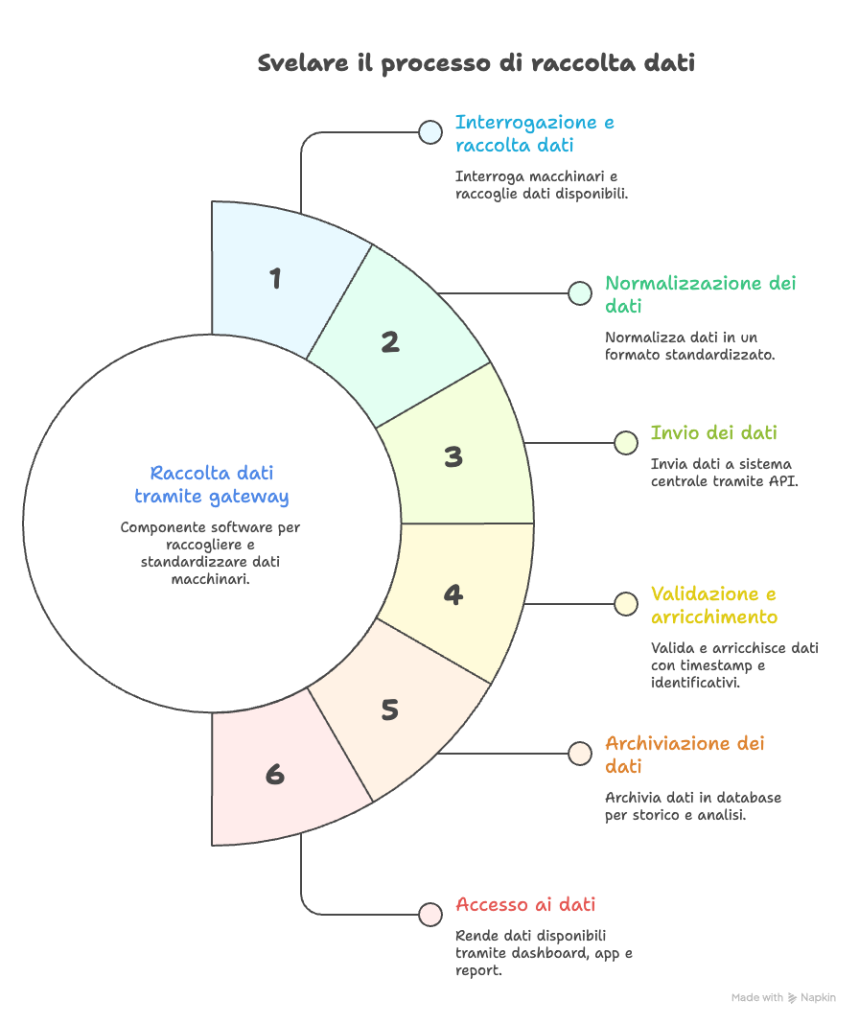
To create this bridge and connect the machinery to the network, Nexeeva uses standard protocols (such as Modbus or OPC-UA), which are essential in industrial automation as they ensure interoperability between devices of different generations and brands. The solution proposed by Nexeeva is based on the implementation of a gateway (NexOne, a software component that can be installed on industrial PCs or servers), which acts as a universal interpreter.
Query: periodically collects data from the machinery.
Standardisation: converts information into a standard, comprehensible format.
Secure transmission: sends enriched data to a central system via secure APIs (Application Programming Interfaces), ensuring maximum integrity and confidentiality.
The data is stored in a database designed to manage information over time and is then made available via reporting systems, web dashboards and internal applications. This enables management to review historical data, carry out comparative analyses and make decisions based on hard facts.
The data journey: from the machine to the dashboard
The process of transforming raw data into strategic information for the company is not straightforward and requires a rigorous and secure framework. The data must pass through various stages, each of which is essential for ensuring its quality and clarity, so that every piece of information reaches the decision-maker’s desk in a clear and timely manner.
• Level 1 (Field): this is where the devices (PLCs, sensors) that generate the raw data are located.
• Level 2 (Protocols): use of industry standards for universal reading.
• Level 3 (Gateway): intelligent organisation and preparation of data.
• Level 4 (Transport): secure, encrypted transmission using technologies such as MQTT or APIs.
• Level 5 (Backend & Storage): storage in databases optimised for historical analysis.
• Level 6 (Visualisation): web dashboards and reports that make the data actionable for operators and management.
From data to value: the competitive advantages of transparent manufacturing
Implementing a data collection and analysis solution is not merely a technological upgrade, but a strategic investment that enables companies to reap immediate benefits:
full accessibility: data that was previously ‘locked away’ in machinery can now be accessed anywhere, and it is possible to see what is happening in real time;
predictive maintenance: by analysing the maintenance history, it is possible to anticipate faults before they cause costly and disruptive production stoppages;
seamless integration: production is no longer an isolated entity but connects with the rest of the business ecosystem (ERP, CRM);
security and scalability: robust protection of sensitive information and a system that grows alongside your business.
Conclusions
Innovation within a company does not necessarily mean dismantling what already exists. However, it is important to rely on an experienced partner who, building on what is already in place, can create a data flow that is simple, scalable and secure.
This approach delivers tangible value right from the start, gradually eliminating blind spots and guiding the company towards full digital maturity.
Would you like more information about Nexeeva’s solutions for collecting and analysing business data?