

Innovation and digital transformation must go hand in hand with data security.
Data protection is not only a legal obligation but also a cornerstone of trust between a company and its customers.
In this article, we explore what the European regulation governing the processing and protection of personal data entails, who needs to comply with it, and why it is important to build a ‘digital fortress’
What is the GDPR and what is it for?
The GDPR (General Data Protection Regulation) is the European Union Regulation (EU) 2016/679 governing the processing and protection of personal data, which came into full effect in all EU Member States on 25 May 2018.
This legislation sets out strict rules on how companies, organisations and professionals must collect, use and protect sensitive data such as names, email addresses and telephone numbers.
The main aim is to ensure that personal data is handled with the utmost care, safeguarding individuals’ fundamental rights and freedoms.
Download the EU Regulation 2016/679 here: a summary for businesses and organisations
. To find out more about the GDPR, you can visit the Information Commissioner’s Office website and the gdpr.eu website
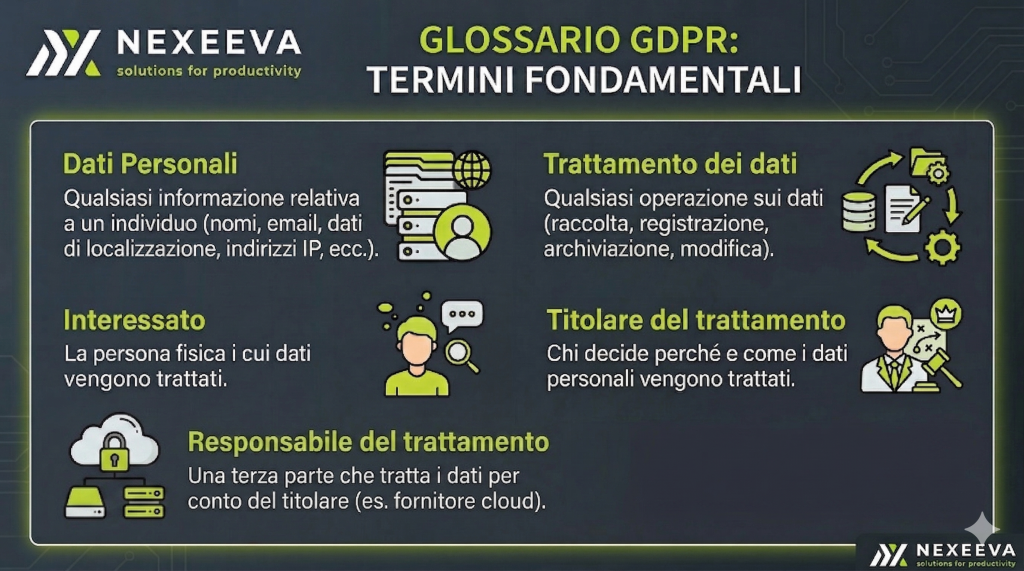
GDPR Glossary
To understand the GDPR, you need to be familiar with a few key terms:
- Personal data: any information relating to an individual who can be identified, either directly or indirectly (names, email addresses, location data, IP addresses, etc.).
- Data processing: any operation carried out on data, whether manual or automated (collection, recording, storage, modification).
- Data subject: the natural person whose data is being processed.
- Data controller: the person or organisation that decides why and how personal data is processed.
- Data processor: a third party that processes data on behalf of the data controller (for example, a cloud service provider).
Article 5: The principles of the GDPR
At the heart of European legislation is Article 5, which sets out the fundamental principles that must be observed in all processing of personal data:
- Lawfulness, fairness and transparency: data processing must have a valid legal basis (lawfulness), must be carried out in a manner that is fair to the individual (fairness), and the methods and purposes must be communicated clearly and transparently (transparency).
- Purpose limitation: data must be collected for specified, explicit and legitimate purposes. Any subsequent processing that is incompatible with those initial purposes is not permitted.
- Data minimisation: only data that is strictly necessary, appropriate and relevant to the stated purposes should be collected and processed.
- Accuracy and precision: data must be accurate and, where necessary, up to date. An efficient system must allow for the prompt deletion or correction of incorrect information.
- Retention limit: data must not be retained for longer than is necessary.
- Integrity and confidentiality: data must be protected against unauthorised access, accidental loss or damage, using appropriate technical measures (such as encryption).
Article 5 also introduces the principle of accountability, according to which the data controller is directly responsible for complying with all the principles of the GDPR and must be able to demonstrate compliance with all the principles listed above.
Data controllers are required to report personal data breaches. All public authorities and organisations carrying out certain high-risk data processing operations must also appoint a data protection officer.
Accountability requires a proactive approach from organisations, which must maintain appropriate documentation to account for their activities (such as records of processing, audits and impact assessments) and subject their policies to regular reviews.

Protection of privacy and prevention of breaches
The GDPR must address the challenges posed by digitalisation and the increasing volumes of data processed on a daily basis, whilst safeguarding privacy even in modern contexts such as artificial intelligence and cloud computing.
Furthermore, it must encourage the adoption of preventive measures against data breaches and unauthorised access, such as end-to-end encryption, multi-factor authentication (MFA), and continuous monitoring using proactive detection solutions to respond promptly to potential breaches.
Who needs to comply?
In accordance with current legislation and the latest updates, compliance with the GDPR is not merely a formality, but an essential operational requirement for almost every business. Today, it is no longer a matter of choice, but an indispensable requirement for operating in the market.
The compliance requirement applies to a wide range of organisations that process personal data (such as names, email addresses, telephone numbers or health data).
Specifically, they must meet the following requirements:
- Companies of all sizes and professionals: from multinationals to small businesses, including the self-employed.
- Public institutions and schools: local authorities, schools of all levels and universities.
- Healthcare sector: GP practices, clinics and healthcare organisations.
- Third sector organisations: parishes, sports clubs and non-profit organisations.
- Property management: block managers.
In short, anyone who processes third-party data is responsible for ensuring its security. Businesses and organisations, in particular, face modern challenges:
- Build data protection into the design of every new system or piece of software from the outset.
- Advanced management of cookies and online tracking.
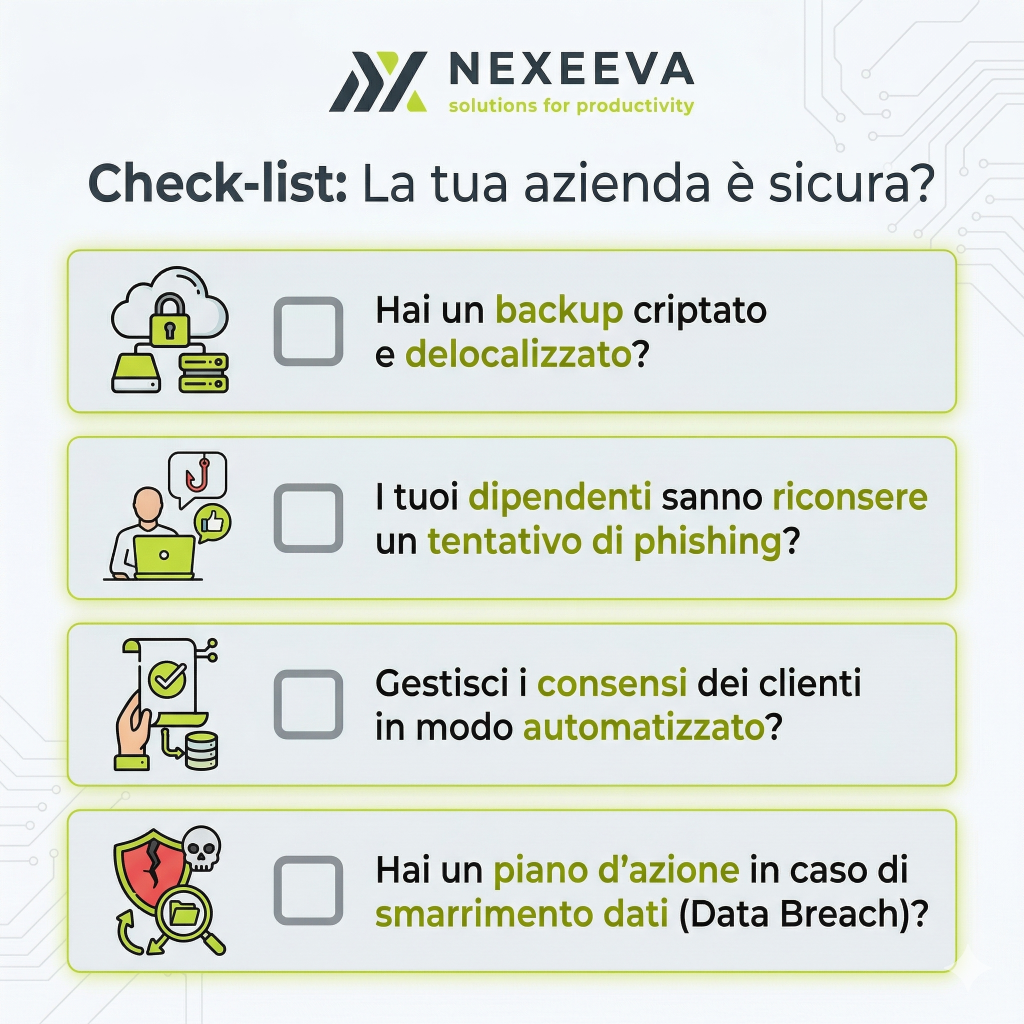
- Data Breach Procedures: rapid and transparent protocols to be implemented in the event of a data breach.
What if you’re not in compliance? You risk fines and inspections
Enforcement of the regulation has become extremely strict over the years. Inspections, which may be triggered by a complaint or as a result of ‘ripple-effect’ checks during audits of other organisations, are on the rise.
The consequences for those who fail to comply are severe: in 2025, penalties hit not only the tech giants hard, but also smaller businesses, with ever-increasing fines that can jeopardise a company’s financial stability.
Failure to comply with the GDPR results in very heavy fines:
- Up to €20 million or 4% of global annual turnover (whichever is higher), depending on the severity of the infringement.
- In addition to fines, the authorities may impose a complete ban on data processing, bringing business operations to a standstill.
Nexeeva guides you towards full compliance
We know that dealing with the red tape and technical aspects of the GDPR can seem like a Herculean task. That is why Nexeeva offers businesses and organisations a ‘turnkey’ GDPR compliance and management service.
Thanks to our collaboration with specialist partners and expert consultants, we oversee the entire compliance process from start to finish:
- Initial analysis: we assess the current state of your business to identify any critical issues and determine whether data is being processed in compliance with the regulations.
- Digital compliance: we check the compliance of websites and social media channels: incorrect management of cookies or online tracking is one of the most common and frequently penalised breaches.
- IT infrastructure: we secure your systems to prevent attacks and data loss. Securing your systems (encryption, backups, firewalls) drastically reduces the likelihood of a data breach. In the event of an incident, being able to demonstrate that you have implemented secure infrastructure is a key mitigating factor that can prevent or drastically reduce financial penalties.
- Legal and documentation support: we handle the drafting of privacy notices and the appointment of key roles such as the Data Protection Officer (DPO).
- Training: The GDPR requires that anyone processing data be properly trained, so we organise specific courses for employees, because security always starts with people. Over 70% of data breaches are caused by human error (emails sent to the wrong recipient, weak passwords, clicking on phishing links).

For example, many companies are unaware that, in the event of a cyberattack, they have just 72 hours to take action.
Nexeeva not only secures your infrastructure to prevent such breaches, but also helps you appoint an experienced Data Protection Officer who knows how to handle such emergencies, turning a potential disaster into a professionally managed and compliant situation.
Here are the benefits you can enjoy if, as a business, you choose to work with an experienced partner who can support you through the process of GDPR compliance:
- Reputation: a company that takes care of its data is a company that can be trusted.
- Efficiency: less clutter in databases means faster processes.
- Business continuity: prevent business disruptions caused by cyber attacks.
Conclusion: it’s best to be GDPR-compliant!
Protecting your data means protecting the future of your business.
Don’t wait for an audit: turn compliance into a competitive advantage and a guarantee of reliability for your customers right away, by implementing bespoke solutions to ensure that every business process is GDPR-compliant from the outset.
Do you want to secure your business?